


By Erin Phelan
Fitness Industry Council of Canada
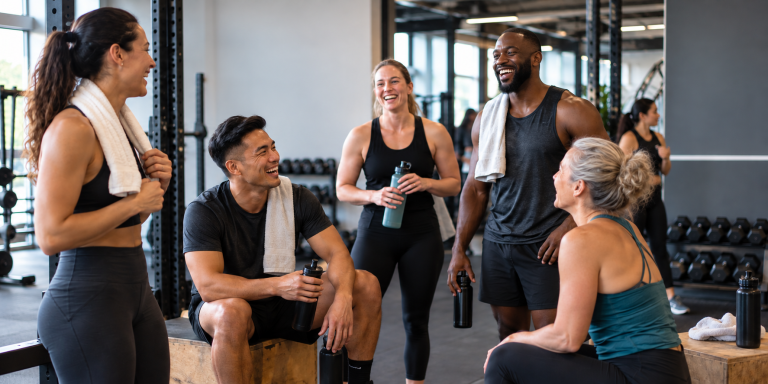
You walk into the gym and the person at the front desk welcomes you back like a long-lost relative. The instructor notices you weren’t there last week. Someone saves you a bike in spin class. Maybe you train every Tuesday and Thursday alongside the same group of people, and eventually recognizing each other becomes talking to each other, which becomes grabbing coffee, matcha or even dinner together afterward.
The gym used to be a place where we went in, did the work and left. Now it’s social hour, every hour – and that might matter more than we realize.
We hear the term “loneliness epidemic” so often that it is worth asking whether the data actually supports it. It does. According to Statistics Canada, 13 per cent of Canadians aged 15 and older reported often or always feeling lonely in the first quarter of 2024. Among Canadians aged 15 to 24, that number climbed to 17 per cent, while 14 per cent of Canadians aged 25 to 54 reported the same thing.
Loneliness is not a young-person problem or an old-person problem. It is a human problem, and the fitness industry may be sitting on part of the solution.
Are we measuring only part of the benefit?
For decades, our industry has measured what happens to people physically when they exercise: strength, cardiovascular fitness, body composition, mobility and chronic disease risk. We also measure mental health – depression, stress and anxiety – and all of this matters enormously.
Perhaps, however, one of the most important things happening inside fitness facilities across Canada has nothing to do with a dumbbell or treadmill.
ABC Fitness’s 2025 Wellness Watch report found that 57 per cent of surveyed active consumers said social interaction and connection were the main reasons they joined a fitness community, and nearly half of Gen Z respondents identified community as the primary reason they stick with fitness. More recent 2026 ABC Fitness research makes the connection even stronger: 67 per cent said fitness communities increase their motivation and accountability, and 57 per cent said community significantly affects their long-term commitment to an active lifestyle.
For an industry that spends enormous amounts of time and money thinking about acquisition, engagement and retention, those numbers should get our attention. What if belonging is not simply a pleasant side effect of membership, but part of the product?
Is the gym becoming our new third place?
The term “third place,” coined by sociologist Ray Oldenburg, describes the informal places where people gather outside home and work – traditionally cafés, community centres, libraries, churches, clubs and the neighbourhood bar.
But the way we socialize is changing. Remote and hybrid work have reduced the everyday interactions that once happened naturally at the office, and our relationship with alcohol is shifting too. Statistics Canada recently reported that the share of Canadians who hadn’t had a drink in the past year rose from 23 per cent in 2015 to 29 per cent in 2024.
So where are people gathering instead?
Look at the rise of run clubs, pickleball, climbing gyms, small-group training and fitness events that are as much about the people as the workout. For some, Saturday morning’s run club has become Friday night’s happy hour – the drink afterward might just be coffee or a protein-packed smoothie.
Fitness facilities have something particularly valuable to offer as a third place: people repeatedly show up and do something together, and over time, the person on the bike beside you stops being a stranger.
The science of showing up
A 2026 systematic review of 21 studies on adherence in adult instructor-led group fitness found self-efficacy – our belief that we can overcome the barriers to exercising – was the factor most consistently linked to adherence. But the social findings were just as interesting: simply having supportive people around wasn’t consistently linked to better adherence. What mattered more was feeling connected to the actual group, knowing the people and identifying with them.
For our industry, that distinction matters: filling a room with people doesn’t automatically create community. People need to feel like they belong in it.
There’s also emerging evidence that group exercise may improve social connection itself. The Cedars-Sinai Leveraging Exercise to Age in Place, or LEAP, study followed 382 adults aged 52 to 104 through community-based group health classes in Los Angeles and found a 6.9 per cent decrease in loneliness and a 3.3 per cent improvement in social connectedness after six months.
Neither study lets us say belonging causes adherence, or that group exercise cures loneliness, but both give us good reason to think more seriously about the social environments we create.
Belonging is good for people and good for business
Adherence has always been one of our industry’s biggest challenges. We’re very good at getting people excited about starting an exercise program; keeping them exercising month after month is considerably harder.
Perhaps we’ve spent too much time asking how we motivate people to exercise, and not enough time asking how we create places people actually want to come back to. The person who saves your bike matters, as does the instructor who notices when you miss a class. None of this replaces knowledgeable fitness professionals or thoughtful programming, but it may be part of why people keep returning to use them.
For operators, this means thinking beyond equipment utilization and class attendance, and asking whether we’re creating opportunities for relationships to form, whether new members feel welcomed, and whether our programming gives people a reason to encounter the same faces week after week.
Perhaps the most important question is the simplest: if one of our members stopped showing up tomorrow, would anybody notice?
The fitness industry cannot solve loneliness on its own, and joining a gym is not a substitute for meaningful relationships, mental-health care or broader community support. What our industry can do is recognize that every day, Canadians walk through our doors wanting to become healthier – and while they’re there, they may also meet people who become part of their lives.
And millions of Canadians have yet to walk through our doors. We must recognize the vast opportunity we have to create a safe, inviting community for them to belong to.
For years, we’ve asked Canadians to come through our doors because exercise can help them live longer. Perhaps there’s another reason to invite them in: it might help them feel less alone while they’re living.
Fitness Industry Council of Canada (FIC) is the not-for profit trade association that represents the voice of fitness facility operators across Canada. Representing more than 6,000 facilities with more than six-million members nationwide, FIC pursues a legislative agenda in the hope of bettering the fitness industry for both consumers and operators. FIC aims to work with both industry and government to improve the health and physical activity levels of Canadians.


